A finance manager approving a vendor payment doesn't stop to think about cryptography. She thinks about whether the approval will hold up if the vendor disputes it later, whether the auditor will accept it, and whether she can get it done before the payment cycle closes. Somewhere in that decision, without an?yone really naming it, she has to choose between three things that all look the same on a screen but behave very differently in a courtroom, a tax filing, or a bank's compliance review: an electronic signature, a Digital Signature, and Aadhaar eSign.
Most
businesses in India don't choose deliberately. They pick whatever their
software offers by default and assume the legal weight is identical. It isn't.
The Information Technology Act, 2000 treats these as distinct categories, and
that distinction quietly decides whether a signed document is a formality or a
liability waiting to surface. An HR team sending offer letters, a founder
signing an NDA with an investor, and a Company Secretary filing a board resolution
with the MCA are technically all "signing something." Legally, they
may need three different tools to do it properly.
An
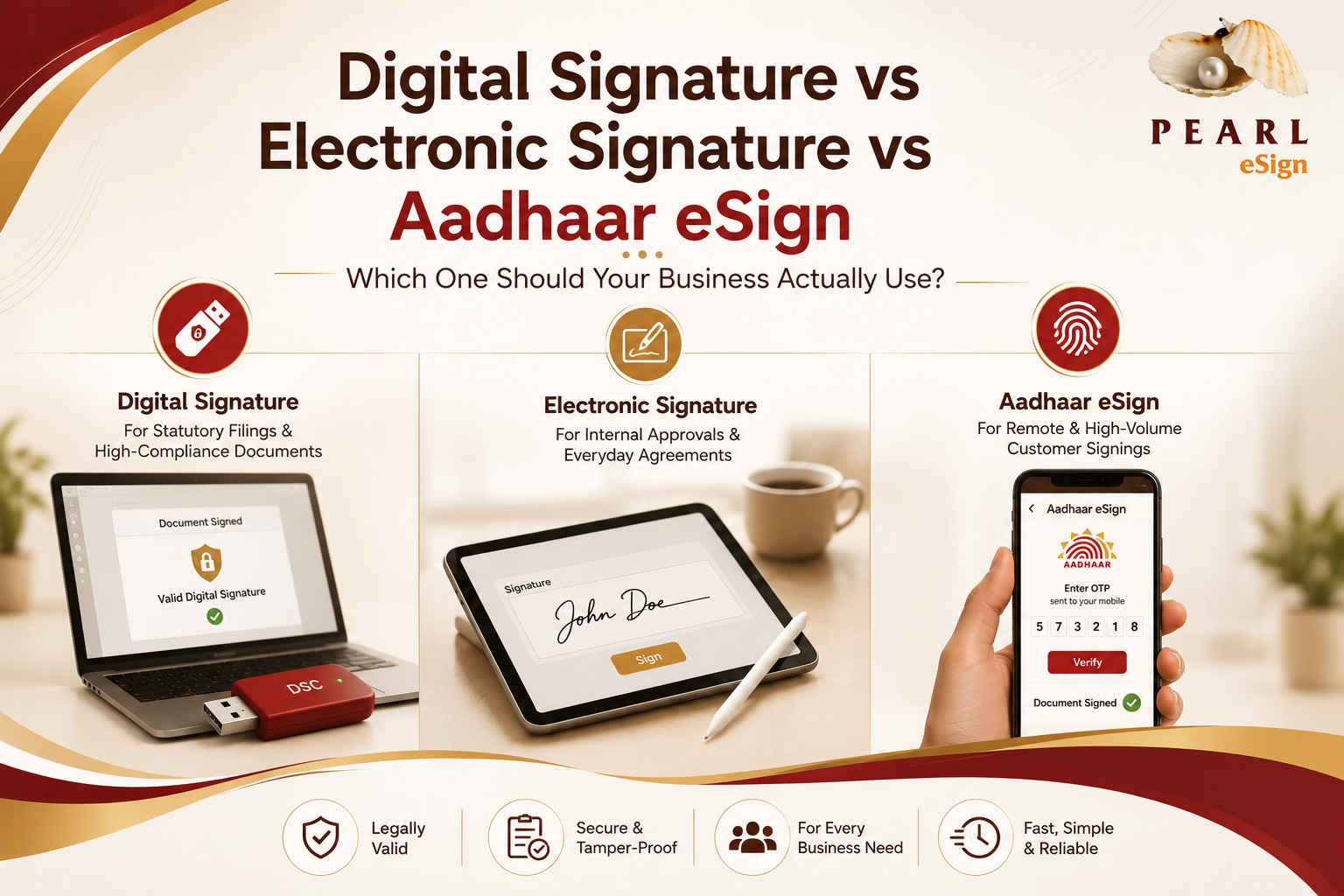
electronic signature is the broadest and least demanding of the three. It
covers anything that shows intent to sign electronically, a typed name, a
scanned signature image, or a click on "I agree." It works well for
internal approvals, HR onboarding, marketing agreements, and low-risk vendor
contracts where both parties trust each other and the stakes of a dispute are manageable.
What it doesn't offer is strong, independently verifiable proof of who actually
signed and whether the document was altered afterward. If a vendor contract
later ends up in arbitration, an electronic signature alone often isn't enough
to settle the question of authenticity.
A Digital
Signature is where that gap closes. It's built on asymmetric cryptography and
issued through a Digital Signature Certificate from a Certifying Authority
licensed by the Controller of Certifying Authorities. A Class 3 DSC, usually stored
on a USB token, binds a signature to a verified identity in a way that's
mathematically tamper evident. This is why the MCA, the Income Tax portal, GST filings, DGFT, ICEGATE, and GeM all
require it for statutory submissions. A Chartered Accountant filing tax audit
reports, a Company Secretary submitting ROC forms, or a Director completing
Director KYC isn't choosing a Digital Signature for extra security theatre.
It's the only format these government systems will accept, and skipping it
means the filing simply doesn't go through.
Aadhaar
eSign sits in an interesting middle position. It uses UIDAI's Aadhaar authentication,
typically an OTP or biometric check, to generate a signature backed by a
licensed Certifying Authority in real time, without requiring a physical USB
token. It carries strong legal standing and is genuinely convenient for
high-volume, remote signing, which is exactly why insurance companies, NBFCs,
and banks use it for loan agreements and policy documents where the customer is
signing from home. The tradeoff is that it depends on the signer having Aadhaar
linked to a live mobile number, which can be a real constraint for NRIs,
foreign entities, or large enterprises signing hundreds of contracts through a
controlled internal workflow rather than a one-time individual authentication.
Once you
place these three side by side, the decision stops being about which one is
"best" and starts being about what the document is actually for.
Offer letters, internal memos, and low-value vendor agreements are usually well
served by an electronic signature. Anything filed with the MCA, ROC, GST, or
Income Tax department needs a proper Digital Signature Certificate, no
exceptions. Loan agreements, insurance policies, and high-volume
customer-facing contracts, especially where the signer is remote and needs a
fast, biometric-backed process, tend to fit Aadhaar eSign best. Companies that
get this wrong don't usually find out immediately. They find out during an
audit, a legal dispute, or a rejected government filing, which is a far more
expensive time to learn it.
The
businesses that handle this well aren't the ones with the most legal knowledge
in-house. They're the ones using a platform that lets different teams use the
right signature type for the right document without switching tools every time.
Pearl eSign was built around that reality. It supports Digital Signature
Certificates for statutory filings, Aadhaar eSign for remote and high-volume
signing, and standard electronic signatures for everyday approvals, all inside
one workflow with API integration, bulk PDF signing, and audit trails that hold
up when someone eventually asks for proof. Teams stop maintaining three
separate processes and start managing one that adapts to the document in front
of them.
If your
organisation regularly handles MCA or ROC filings, our guide on MCA & ROC
Filing with Digital Signatures walks through the complete process end to end,
and if you're weighing legal enforceability more broadly, Are Digital
Signatures Legal in India? covers how courts and regulators actually treat each
format. For teams that still need to purchase or renew a Class 3 DSC before any
of this becomes relevant, MCS DigiSign handles that step directly.
As more
approvals move online, the real competitive edge isn't signing faster. It's
knowing which signature protects the business when someone eventually pushes
back on a document, and having a system already in place that doesn't force a
scramble to figure it out after the fact.
Ready to Implement Digital Signatures in Your Organization?
Schedule a personalized demo with Pearl eSign's enterprise solutions team. We'll walk you through the platform and design a deployment strategy tailored to your organization's workflows.