Not very long ago, signing an important business document meant printing multiple copies, chasing approvals, arranging couriers, scanning signed pages, and filing them away for future reference. It wasn't a process anyone particularly enjoyed, but it was accepted as the only way to ensure a document carried legal weight. A signature represented trust, accountability, and commitment, and for decades that trust was tied to ink on paper.
Business
doesn't work that way anymore.
Today,
contracts are negotiated over video calls, vendors operate across different
states, employees join organisations without ever visiting a physical office,
and statutory filings are submitted online within minutes. Documents travel
faster than people, decisions are made across time zones, and organisations
expect approvals to happen almost instantly. As businesses continue embracing
digital workflows, one question naturally becomes more important than ever: Are
Digital Signatures actually legal in India?
It's a
question worth asking because every signature carries responsibility. Whether
it's a supplier agreement, an employment contract, a board resolution, or an
MCA filing, the signature isn't simply a formality at the bottom of a page. It
confirms that the right person approved the document, accepted its contents,
and can be held accountable for that decision. Replacing a handwritten
signature with a digital one only makes sense if the same level of trust continues
to exist.
The
reassuring part is that businesses don't need to guess. Digital Signatures have
been legally recognised in India for more than two decades, and they're already
embedded into the way organisations, government departments, financial institutions,
and compliance professionals operate every single day. Every time a Chartered
Accountant files documents through the MCA portal, a Company Secretary
completes statutory compliance, or a business submits information to the Income
Tax Department, Digital Signatures quietly do the work of establishing
identity, protecting documents, and ensuring authenticity.
What
often creates confusion is that many people use the terms Electronic
Signature and Digital Signature interchangeably. They look similar from
the outside because both allow documents to be signed electronically, but they
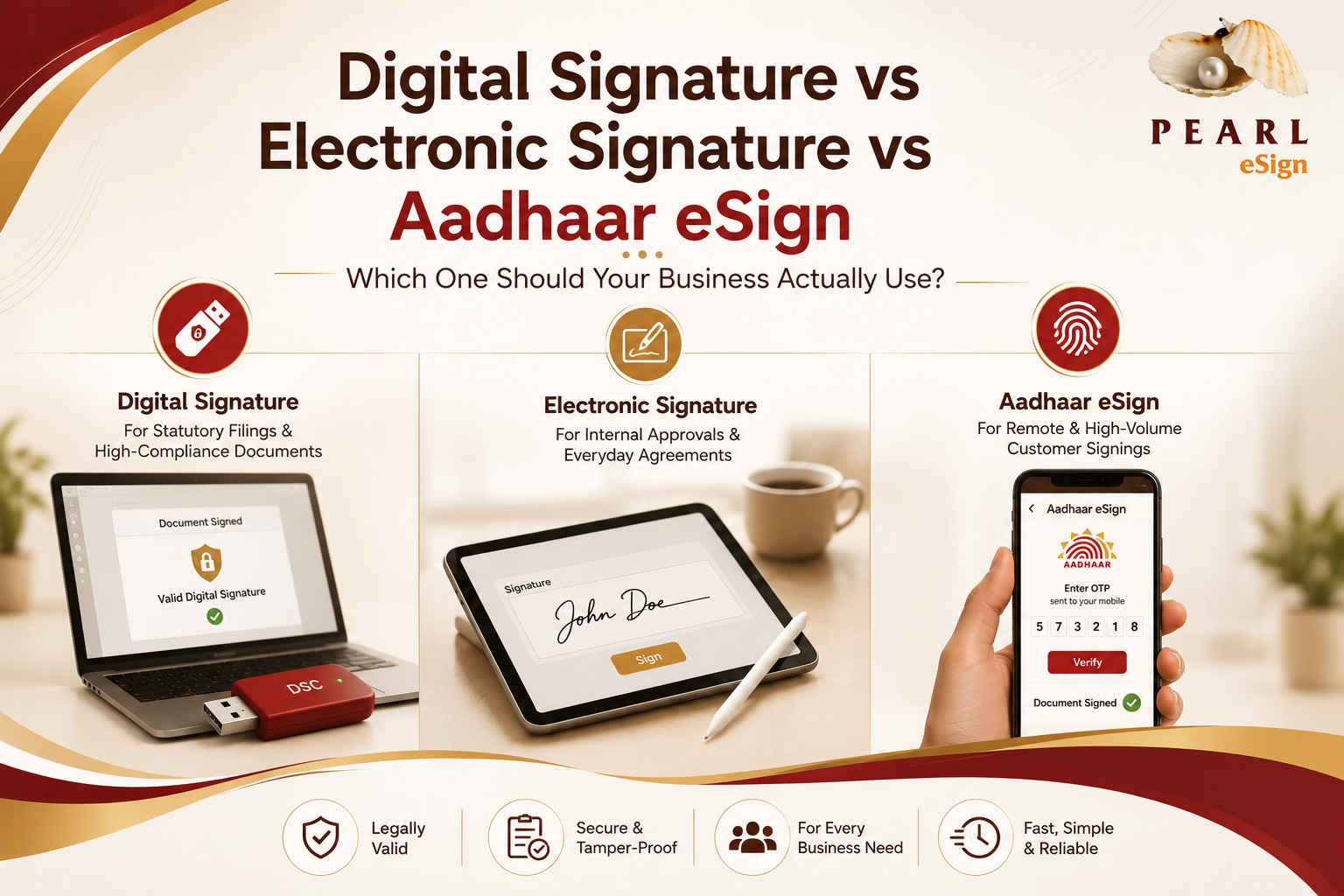
serve very different purposes. An electronic signature records intent, while a
Digital Signature goes much further by verifying identity and protecting the
document through encryption. If you're unsure about the distinction, our guide
on Digital Signature vs Electronic Signature explains where each fits
and why businesses often use both depending on the nature of the transaction.
The legal
validity of a Digital Signature comes from the Information Technology Act,
2000, legislation that recognised electronic records and established the
legal framework for secure digital transactions in India. More importantly, it
introduced the concept of a Digital Signature Certificate (DSC) issued
by licensed Certifying Authorities. That certificate is what transforms a
digital approval into a legally recognised signature. It links the signer to
the document, verifies their identity, and immediately detects any modification
made after the document has been signed. This is why Digital Signatures are
accepted for MCA and ROC filings, Income Tax submissions, GST documentation,
government tenders, banking processes, and countless other compliance-driven
activities where authenticity cannot be compromised.
The law,
however, is only part of the story. Businesses rarely adopt Digital Signatures
simply because legislation permits them. They adopt them because the
traditional way of managing approvals no longer keeps pace with the way
organisations work. Every business has experienced documents sitting in inboxes
waiting for signatures, contracts moving back and forth because the wrong
version was approved, or compliance teams scrambling to complete filings before
a deadline because one physical signature is still pending. These aren't
technology problems; they're workflow problems.
Digital
Signatures solve those workflow problems while strengthening trust rather than
weakening it. Instead of printing, scanning, couriering, and manually tracking
documents, organisations can complete approvals securely from anywhere while
maintaining a complete audit trail. Every signature can be verified, every
document remains protected against tampering, and every approval is recorded
with far greater transparency than traditional paper-based processes ever
allowed. For organisations handling dozens of documents each month, the
improvement is noticeable. For enterprises processing thousands of agreements,
statutory filings, purchase orders, and financial approvals, the impact is
transformational.
This is
also why businesses are beginning to look beyond individual Digital Signature
Certificates and towards complete signing workflows. Managing one DSC isn't
difficult. Managing multiple certificates across departments, tracking
approvals, maintaining version control, and ensuring compliance across hundreds
of documents quickly becomes a much larger operational challenge. Platforms
such as Pearl eSign bring these processes together by combining Digital
Signature Certificate support, bulk PDF signing, secure approval workflows,
document management, and API integrations into a single environment. Instead of
treating document signing as a standalone task, organisations build a process
that is secure, scalable, and easy to manage as the business grows.
Perhaps
that's why the conversation has changed so much over the last few years.
Businesses are no longer asking whether Digital Signatures are legal. That
question has already been answered. The conversations today revolve around efficiency,
security, governance, and trust. Organisations want approvals to happen faster
without compromising compliance. They want documents that can be verified years
later. They want systems that reduce administrative effort while increasing
confidence in every transaction.
In many
ways, Digital Signatures represent much more than the replacement of ink on
paper. They represent a shift in how organisations establish trust in a digital
world. As businesses continue moving towards paperless operations, remote
collaboration, and digital-first processes, the value of a legally recognised,
secure, and verifiable signature becomes increasingly clear. The technology may
sit quietly in the background, but the confidence it creates influences every
important decision a business makes.
Ready to Implement Digital Signatures in Your Organization?
Schedule a personalized demo with Pearl eSign's enterprise solutions team. We'll walk you through the platform and design a deployment strategy tailored to your organization's workflows.