If you've signed a document online recently, you've probably come across the
terms electronic signature and digital signature. Sometimes you're asked to type your name or click an approval button, while
other platforms require a Digital Signature Certificate (DSC)
before the document can be submitted. To most users, both experiences feel
exactly the same. The document is signed, the work is complete, and everyone
moves on.
The difference, however, isn't in how the signature looks. It's in what the
signature is expected to prove.
Businesses today sign everything from employment contracts and vendor
agreements to purchase orders, customer documents, and statutory filings. Some
of these documents simply need confirmation that both parties agreed to the
terms. Others need to prove who signed them, ensure the document hasn't been
altered after approval, and satisfy legal or regulatory requirements. That's
where understanding the difference between an Electronic Signature and a
Digital Signature becomes important.
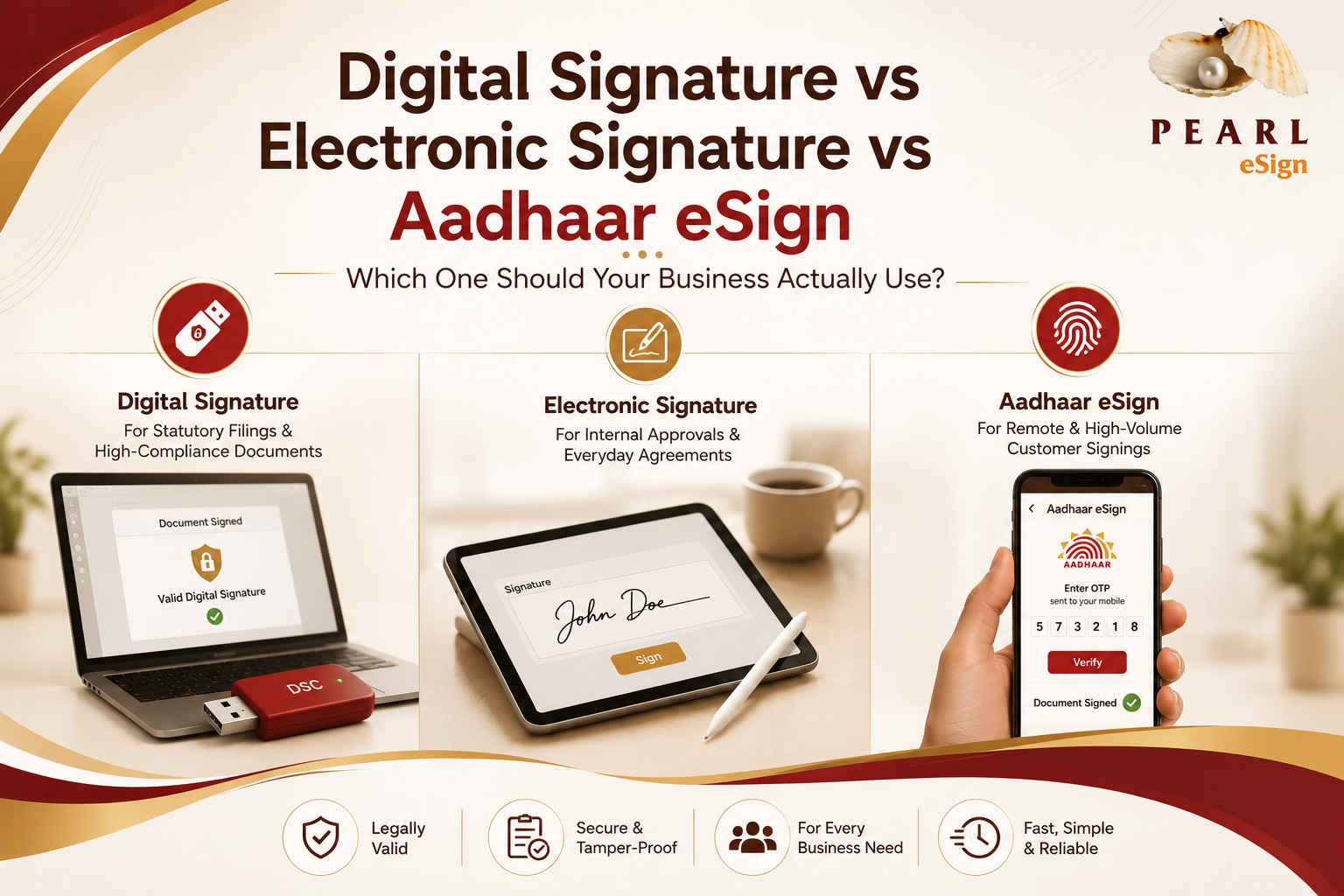
An Electronic Signature is designed to record consent.
Whether someone types their name, draws a signature on a screen, confirms
through an OTP, or clicks Accept, the objective is
straightforward: capture approval electronically and keep the process moving.
It's an ideal choice for HR documentation, customer agreements, internal
approvals, onboarding forms, and other everyday business activities where speed
and convenience matter more than advanced authentication.
A Digital Signature is built for situations where approval
alone isn't enough. Using encryption and a Digital Signature
Certificate, it verifies the identity of the signer and protects the
document from being modified after signing. If the document changes, the
signature immediately becomes invalid, making tampering easy to detect. This
additional layer of security is what gives digital signatures their legal and
compliance value.
The distinction becomes much clearer when viewed through real business
scenarios. An HR manager sending an offer letter simply needs confirmation that
the candidate has accepted the role. An Electronic Signature completes that
process quickly without adding unnecessary complexity. A Chartered Accountant
filing documents with the Ministry of Corporate Affairs (MCA),
however, needs much more than confirmation. Those filings require verified
identity, document integrity, and compliance with government requirements. The
same applies to ROC filings, Income Tax submissions,
GST registrations, government tenders, banking documentation,
and several other statutory processes where a valid Digital Signature
Certificate is mandatory.
Many organisations only recognise this difference once they begin scaling.
As document volumes increase, approvals move across finance teams, legal
departments, HR, procurement, auditors, clients, and government authorities.
The challenge is no longer collecting signatures. It's ensuring every approval
is genuine, every document remains secure, and every step of the process can be
verified whenever required.
That's why Digital Signatures have become much more tha?n a compliance
requirement. They help businesses build structured approval processes where
every signed document ca?rries verified identity, every action is recorded
through an audit trail, and every stakehold?er works with confidence. Instead of
relying on email chains, printed documents, and manual follow-ups,
organizations gain a workflow that's easier to manage, easier to audit, and
significantly more secure.
If your organization regularly handles MCA filings, ROC
compliance, Income Tax, GST,
contracts, or high-value business approvals, understanding this distinction is
essential. You can also explore our guides on Digital Signature
Certificates and MCA & ROC Filing with Digital Signatures
to understand where certificate-based signing is required and how it simplifies
compliance.
As businesses continue moving towards digital operations, document signing
is no longer just about replacing pen and paper. It's about creating approval
processes that are secure, reliable, and capable of supporting growth. Routine
documents benefit from the speed and simplicity of electronic signatures, while
business-critical documents demand the stronger authentication and legal
recognition provided by digital signatures.
That's the philosophy behind Pearl eSign. Whether you're
signing statutory documents using a Digital Signature Certificate,
processing large volumes of PDFs, managing enterprise approvals, or integrating
secure signing into your existing ERP or business applications, Pearl eSign
brings the entire workflow into a single secure platform. Instead of treating
document signing as a separate task, businesses can manage approvals with
greater consistency, stronger security, and far less manual effort.
Choosing between an electronic signature and a digital signature isn't about deciding which technology is better. It's about understanding the purpose of the document, the level of trust it requires, and the compliance obligations surrounding it. Once that distinction is clear, building secure and efficient document workflows becomes much simpler, allowing to spend less time managing paperwork and more time moving work forward
Ready to Implement Digital Signatures in Your Organization?
Schedule a personalized demo with Pearl eSign's enterprise solutions team. We'll walk you through the platform and design a deployment strategy tailored to your organization's workflows.